.png)
How Do Bond-Funded Sports Field Projects Get Planned — And When Should the Conversation Start?

Updated: Sep 24
Bond-funded sports field projects need 12 to 18 months of lead time before groundbreaking, and the scope needs a field contractor's input before it goes into a bid document. Once the scope locks, so does the budget. Put a field contractor in the room early and the project finishes on time — skip that step and expect change orders.
The bond-funded projects that go well had a sports field contractor in the room before the scope was written. The ones that go sideways handed that scope to a general contractor or an architect who's never actually installed drainage under a natural grass field. By the time you begin to break ground, the budget is already wrong.
Why does bond funding change the planning timeline for a sports field project?
A standard maintenance contract moves at the pace of a relationship. Call on Monday, scope on Wednesday, work starts in three weeks.
Bond-funded projects don't work that way. Competitive bid requirements, board approval at every checkpoint, and a fixed bid window add months before a shovel touches the ground. A realistic minimum — one bid cycle, no delays, no design complications — is 9 to 12 months from scope to groundbreaking. Add a re-bid because the first round came in over budget, or a permitting delay, or a natural grass planting window the calendar missed, and you're looking at another season gone.
That's why 12 to 18 months of lead time is the number. Anything tighter and the schedule or the budget — usually both — get set by people who've never built a field.
The other thing bond money does is lock the scope. Once a project goes to bid, what's on paper is what gets built. There's little room to adjust scope once it's public. That's the planning stage's entire job: get the scope right before it goes out the door.
What do bond-funded sports field scopes consistently get wrong — and who pays for it?
The same two things often show up on project after project, and they both trace back to the same root cause: nobody who actually builds fields had a seat when the scope was written.
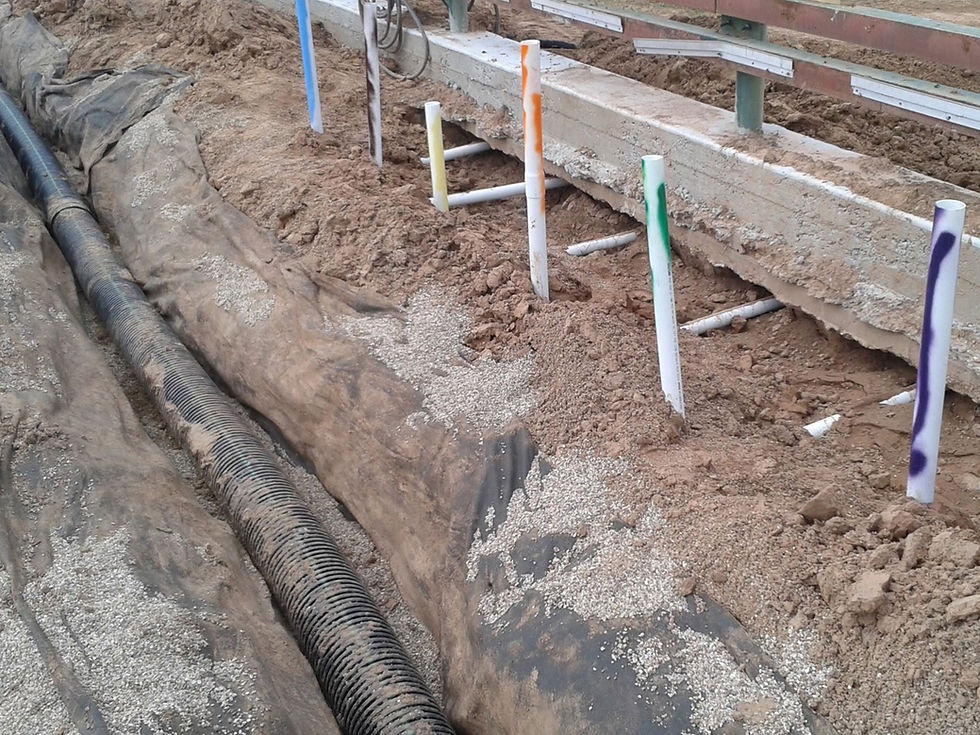
Drainage gets shorted. It's underground, it's invisible in the budget, and it's the first place to cut a number without realizing what you're cutting. Subgrade is the same story. People budget what they can see. A field that starts holding water two seasons in isn't a maintenance problem — it's a scope problem that was locked in before the first bid was read.
The calendar gets picked around football season instead of around grow-in. Natural grass needs time after installation before it can take traffic — 90 days at absolute minimum, longer depending on species, time of year, sprigging vs sodding, and other unforeseen details. Miss the planting window and the field opens up too early or even completely unplayable. That's not a contractor problem, it's a planning problem.
Irrigation gets specced by head count with nobody checking water pressure.
Synthetic turf gets priced like a commodity when the base underneath — the subgrade, the drainage, the compaction — is what actually determines how long it lasts.
Change orders are how these mistakes get paid for. And on a bond-funded project with a fixed budget, change orders mean something else doesn't get built.
When should you bring a field contractor into the planning process?
Before the bond passes, if possible. After the bond passes and before the scope goes into a bid document, at the absolute latest.
The single most important thing a Bond Director or Superintendent can do with a capital allocation for athletic fields: get a sports field contractor on site before the scope is written. Whatever's on paper at that point is about to get locked in.
A preliminary site visit — or aerials and whatever build plans exist — gives a field contractor enough to have a real conversation about what the project is actually trying to accomplish: rebuild, renovation, drainage fix, synthetic conversion. From there, a preliminary number with bid alternates gives the board something real to react to before the scope locks.
Three things a field contractor needs before that conversation can be useful: a real budget number, a clear decision-maker, and whether the project is going to public bid or getting negotiated direct. Without those three, the conversation is guesswork on both sides.
How do you get a real preliminary number before the scope locks?
A phone call and aerials gets a rough range. That's useful for a board presentation — a ballpark to sanity-check the capital allocation before any real money gets spent on design or engineering.
A bid-ready number requires a site visit. If the site has known drainage issues, add a drainage survey. Soil reports matter on a full rebuild or a synthetic conversion; they matter less on a light renovation where the existing subgrade is staying in place.
What the project is trying to solve determines what's actually needed. A drainage fix doesn't run like a full field rebuild. A natural grass resurfacing on a field with poor subgrade is actually two projects — fix the base, then install the surface — and pricing it like one is exactly how scopes go wrong.
How does the sequence of work on a bond-funded field project actually run?
The sequence matters because each phase depends on the one before it. Get it out of order and you're redoing work.
Drainage design first — before any grading happens, the drainage plan determines where everything else goes.
Grading — establish the finished surface grades the drainage is designed around.
Subgrade and drainage installation — underground infrastructure before anything gets built on top of it.
Irrigation — roughed in after subgrade is set, before import material goes down.
Import material and laser grading — the finished surface layer, graded to tolerance.
Surface installation — natural grass sodding, sprigging, or synthetic turf system last.
A GC crew that doesn't build fields for a living will grade before the drainage plan is finished, because grading is the part they recognize. Now the grades are wrong, the drainage has to be redesigned around them, and the district pays twice to grade the same field.
The grow-in period sits at the end of that sequence for natural grass — 90 to 120 days of restricted traffic before the field can take competition loads. That window has to be built into the project calendar at the planning stage, not discovered after the field opens.
What happens when a field project gets bundled into a general contractor's scope?
It works fine when the GC brings a sports field contractor in during the design phase. The scope gets written with real field input, the numbers are real, and the execution goes to the right people.
It falls apart when the GC bids the field as a line item — locks a number with no field input — then hands it to a sports field contractor to execute against a scope that was never real. The sports field contractor is now on the hook for a budget that didn't account for actual site conditions, and the Bond Director is on the hook for the change orders.
Most Bond Directors don't know they have another option: bid the athletic field work separately instead of bundling it into the GC's contract. A separate bid package for athletic field work brings the right expertise into the process from the start, and the scope gets written by people who know what goes underground below a sports field. It's a straightforward procurement decision that most districts often never consider because nobody told them it was available.
Planning a sports field project? Talk to Sports Field Solutions before you put it out to bid. A preliminary site visit costs nothing and gives you a number you can actually take to a board meeting.
Frequently Asked Questions
How far in advance should a school district contact a sports field contractor for a bond-funded project?
12 to 18 months before the target groundbreaking date is the realistic window. That covers one full bid cycle, board approval checkpoints, any permitting requirements, and the grow-in period after installation. Projects that start this conversation later almost always end up with a compressed schedule, a locked scope that hasn't had field input, or both.
What is a CIP in the context of a bond-funded sports field project?
CIP stands for Capital Improvement Plan — the multi-year budget document that most school districts and municipalities use to track and prioritize major construction and renovation projects. A sports field project typically shows up in the CIP before bond language is finalized, which is the earliest and best time to start the planning conversation with a field contractor.
What are bid alternates, and why do they matter for athletic field projects?
Bid alternates are line items in a bid package that the owner can add or remove based on the bids that come in. On a sports field project, they're a planning tool: a contractor prices the base scope plus alternates like an upgraded irrigation system, synthetic vs. natural, or a second field, so the board has real numbers before the scope locks. Without them, a project that bids over budget goes back out to bid — adding months and cost.
What's the difference between an RFQ and an RFP for a sports field project?
An RFQ (Request for Qualifications) asks contractors to demonstrate their experience and capacity before pricing is discussed. An RFP (Request for Proposals) asks contractors to submit both qualifications and a price. Many districts use an RFQ first to shortlist qualified contractors, then issue an RFP to that shortlist. The distinction matters because it affects lead time and how early in the process a district needs a defined scope.
What is retainage, and how does it affect a sports field project?
Retainage is a percentage of each payment — typically 5 to 10 percent — that the owner holds back until the project is complete and the punch list is cleared. It's standard on bond-funded construction projects. For a sports field contractor, it means a portion of project revenue is delayed until final acceptance, which is worth understanding when structuring project agreements and timelines.
Can Sports Field Solutions help with a project that is already out to bid or in the design phase?
Yes — though the options narrow the further the project is into the process. If the scope is already locked, the conversation shifts to execution against what's on paper. If the project is still in design, there may be room to review the drainage and subgrade specifications before the scope finalizes. The earlier the conversation, the more it's worth.
The scope that goes to bid is the project you get — see how SFS's development services team gets it right from the start.


Comments