.png)
Baseball & Softball Infield Renovation in Texas: Why Summer Is the Right Window


Baseball and softball infield renovation has a timing sweet spot in Texas — roughly June through mid-August. Miss it and you're competing for whatever calendar openings remain, working around weather delays that compress an already tight timeline, or dealing with a freshly graded infield that can't handle the first big rain before the infield mix has locked up. The facilities that book early get the dates that work for their program. The ones that wait take whatever's left.
Walk a well-maintained baseball field after a full season and you'll see the same story every time. First base is worn down from lead-offs, pickoffs, and the constant back-and-forth of a first baseman holding runners on. The middle infield — shortstop, second base, the transition at the arc — carries depressions from slide traffic and a season of players moving laterally across the skin. Third base gets off easy by comparison. Less traffic, less wear. And along the back arc and the front transition, you've got lips — conditioner and infield mix that migrated into the grass from rain, grooming, and foot traffic until there's a small dam between the skin and the outfield.
This is normal. It happens on every field, even the best-maintained ones. A well-built infield managed by a skilled groundskeeper will still show this wear after a full season of play. The question isn't whether it happens. It's whether you address it during the windows when the work can have the most impact.
What does a baseball or softball field actually look like when it needs renovation?
The signs are easier to read than most ADs realize. Low spots hold water — after a rain event, those depressions at first base, second base, and the shortstop position stay wet long after the rest of the field has drained. That's a grade problem. You can maintain around it all season, but you can't drag it away.
Lips and transitions are the other tell. When the infield mix migrates into the grass along the back arc or the front transition, it builds up over time into a raised edge — a dam that catches water, creates a tripping hazard, and signals that the grade relationship between the skin and the turf has broken down. Standard practice at Sports Field Solutions is to cut out one roll width (four feet) of sod along the back arc at renovation and replace it with fresh material. When the transition issues are severe, we'll cut out additional rolls. It's one of the steps that keeps the grade consistent year over year rather than letting the lips accumulate into a bigger fix down the road.
What does a baseball or softball infield renovation actually include?
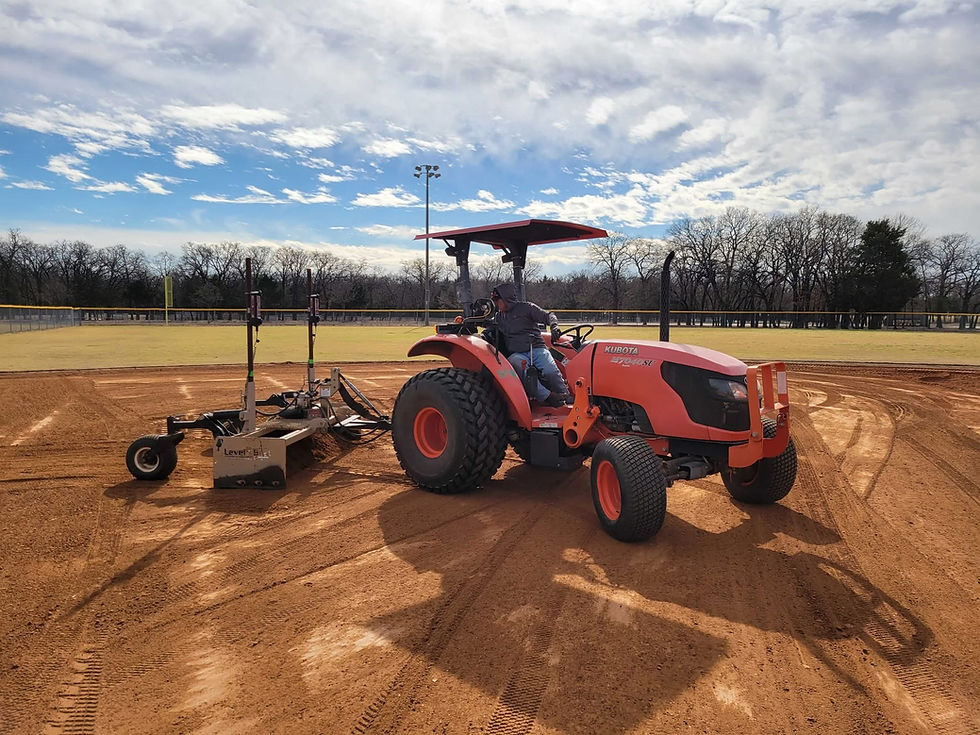
A real infield renovation is not a tune-up. A tune-up is edging, grooming, and spreading conditioner — it improves the surface but leaves the grade untouched. A renovation brings in a tractor and a laser box to actually correct the grade. If your field holds water at the base positions after rain or has lips you can't drag away, you need a renovation.
A typical baseball or softball infield renovation at SFS runs in roughly this order:
String line to either foul pole to square the work with the field
Measure the back arc from the pitcher's rubber to mark the new arch
Remove and cap any irrigation heads in the work area
Bring in infield clay and laser grade the skin surface
Cut out and replace sod along the back arc and front transition as needed
Install fresh sports hybrid bermudagrass around the infield arch
Replace base anchors, home plate, and pitcher's rubber
Spread and groom infield conditioner as a topdressing across the clay areas
Equipment on-site will typically include sod cutters or a fraise mower, a tractor, the laser box, one or two skid steers depending on project size, a tiller attachment, a bunker rake, and a topdresser. On a softball field, we won't till through the pitcher's lane if the facility has bricks installed or has used mound clay under the pitching lane for durability — that's a coordination point we confirm before work begins. From mobilization to field-ready: five working days for softball, seven for baseball.
Why does summer work — and what happens when you miss the window?
The summer window exists for two reasons: the schedule and the weather.
Youth and high school tournament seasons wind down in late May and June. That creates the clearest stretch of unscheduled field time most programs see all year. From June through mid-August, most fields aren't spoken for. The bermudagrass is actively growing, which means sod establishment happens fast. And in most of Texas, June through September is consistently dry — the conditions you want when you're moving clay, laser grading, and laying new sod.
Miss the window and your options begin narrowing. Fall renovation means sourcing bermudagrass sod that's been overseeded with ryegrass at the sod farm — it's more expensive than just bermudagrass sod, and the ryegrass competition hampers bermudagrass establishment. That sod will come out of dormancy in spring behind a field that had a full summer to put down roots without competition. You're paying more for a slower start. Fall ball starts in September, so the scheduling math can't always work past mid-August in several cases. Spring is even tighter: by the time you're through winter and into playing weather, you're already in-season or approaching it. There's no room to mobilize, grade, and let sod take root without pushing someone's schedule.
One note for facilities in the Houston area: plan ahead for hurricane season. Summer renovation is still the right window but lead time and contingency planning matter more in that geography. Austin north, and you're generally clear.
How far out should you book a summer renovation in Texas?
April or May is a great target. That's when the summer calendar is still open, crew availability is uncontested, and you have full control over your start date. By June it's filling. By July you're working around football and soccer projects that got there first — those renovations need to happen in spring and early summer, and they compete for the same crews and equipment. Book in April or May and your program gets the dates it wants. Wait and you take whatever's left.
If you're reading this in August, the window isn't fully closed — but reach out now. Every week matters at this point in the year.
What goes wrong when facilities try to renovate without the right expertise?
The most common mistake is using the wrong material. Infield renovation requires the
right clay — the right composition, the right particle sizing, the right behavior under Texas weather conditions. Facilities that DIY or hire a crew without sports field experience frequently end up with a surface that doesn't drain, compacts differently than the existing skin, or requires a second mobilization to fix.
We've seen it happen. One facility built an infield with warning track material and infield conditioner at six inches depth instead of proper infield clay. The surface didn't drain, didn't play like an infield skin, and required complete removal and replacement — haul off the wrong material, import proper clay, laser grade from scratch. Everything done twice. That's not a hypothetical. That's a real project.
The other thing facilities consistently underestimate is drainage — and specifically the difference between slope drainage and field drainage. These are not the same thing. A field can have a perimeter that drains and still hold water on the skin because the grade within the infield itself is working against you. Understanding that distinction before you sign anything is how you avoid a renovation that solves the wrong problem.
Planning a baseball or softball infield renovation? Talk to SFS before you put it out to bid. The first question we ask is what's your biggest headache and what's your realistic budget — because that conversation shapes everything else.
Frequently Asked Questions
How long does a baseball or softball infield renovation take?
Five working days for softball, seven for baseball — mobilization to field-ready. Scope variations such as additional sod removal, larger skin areas, or drainage complications can extend the timeline. SFS confirms the schedule during the scoping conversation before any work begins.
Is there a difference between a baseball infield renovation and a softball infield renovation?
The scope is nearly identical. The one exception: on softball fields with installed pitching lane bricks or mound clay under the pitcher's lane, SFS does not till through that area. Everything else — lip removal, laser grading, sod replacement, base hardware — runs the same process.
What's the difference between an infield tune-up and a real renovation?
A tune-up is edging, grooming, and conditioner work — it improves the surface without touching the grade. A renovation brings in a tractor and a laser box, which is the only way to actually move material and restore proper drainage slope. The laser box reads the existing elevation across the entire skin and corrects it precisely. You can't replicate that with hand tools.
What equipment does Sports Field Solutions bring on-site for an infield renovation?
Sod cutters or a fraise mower, a tractor with laser box, one or two skid steers depending on project size, a tiller attachment, a bunker rake, and a topdresser. The laser box is the piece most facilities have never seen up close — it reads the existing elevation across the skin and moves material precisely to restore proper drainage slope.
What's the latest a facility can book and still be ready for fall ball?
Mid-August is the outer edge. A renovation started by mid-August gives the sod the establishment time it needs before fall ball begins. Beyond that, the recovery timeline gets tight. If you're approaching that date, reach out now — Sports Field Solutions will assess availability and be direct about what's realistic.
Does infield renovation timing differ between North and South Texas?
The summer window applies statewide, but Houston-area facilities need to account for hurricane season. Weather disruptions during active work create scheduling complications that don't exist further north. Austin and north, the June through mid-August window is generally clean. Sports Field Solutions accounts for geography in every scheduling conversation.
What's the most common mistake when hiring for infield renovation?
Using the wrong material. Infield renovation requires the right clay — the right composition and particle sizing for the way an infield skin needs to drain and play. Crews without sports field construction experience frequently install material that doesn't perform, and the facility ends up doing the job twice. The first question Sports Field Solutions asks is always about the problem and the realistic budget — that's the conversation that keeps the fix from becoming a do-over.
Curious about what SFS can do for your program beyond the infield? From mobile maintenance to full field construction, there's a good chance we're already working on a field near you.


Comments